Friday, October 23, 2009

Quibbling

Dear Noah,

I suppose you're likely NOT a memephile, so I'll just have to point to that comment wherein I declare myself an authoritarian (if not an authority) when it comes to jargonisms. Perhaps you'll find it interesting.

We used to have such lovely words as "gentlewoman" and "trencherman"; and we've got plenty of adjectival constructions, such as "male student" (if you think of "student" as a noun) and "student teacher" (if you think of "student" as an adjective). So why, when speaking of clerical orders these days do we talk of (notional) "women clergy", "women priests", and so forth? Back "in the day", we might speak of "priestesses"; I suppose nowadays that would be considered viricentric/andronomial, or even chauvinist? Or is it perhaps considered paganizing? Do we not like the plain reminder that, for all the echoes of Christianity in paganisms so many modern folk read backwards, there's plenty of pagan custom that Christianity simply never blessed?

Incidentally, Watercloset breeders take note: your task has become so much simpler!


Yours truely,
An Oxford reader; if attrocious speller

Thursday, October 15, 2009

Letters to the Editor

Dear Editor,

Imagine, if you will, the following counterfactual: Nikita Kruschev secretly visits Hawaii to talk to a local hippy commune about modern farming techniques; President Johnson gets to hear about it, has an angry talk with Kruschev about it on the Red Phone, but news of the event leaks and then Johnson lets it be known around the world in no uncertain terms that Heads of State can't just waltz around doing whatever they want and saying whatever they want in any Country they please, but really ought to let the local officials know beforehand and get their permission, etc. And I'm sure that most of the free world would privately agree with LBJ while publically laughing about Niki's daring stunt; and thankfully the MAD policies would keep us all from burning up quickly or freezing and starving under a dusty-red sky and poison rain. Nonetheless, we understand and aprove the principle, in a sensible context.

So, nowadays Presidents of the United States like to pull their own stunt visits to places like Free Iraq and the Republic of Kabul; but many Catholic bishops, the Church's dukes and princes, take their duty and right to govern the Particular Churches rather more seriously. It's scandal sufficient when bishops fall into and preach heresy; but to then impose their unrepentant selves under a cloud of episcopal dignity on the flock of a brother bishop goes remarkably farther to both erode episcopal dignity in general and undermine any of that other bishop's efforts to correctly teach and govern those in his care.

It's the same principle, only the stakes are much more dire --- the immortal souls of all people, not just our comfort in this life.

a tired reader of Fr. Z

Monday, October 5, 2009

Joy!

Dear Photons,

You may recall that Seraphic encouraged such young folks as hope to marry to blog Joyfully. That is, to blog with JOY


So, to balance the irk --- ahem ---


irk

expressed some time ago, I would like to report to you Light Quanta that this latest pre-weekend, I had the pleasure of meeting one or two charming folks who are trying --- among other things --- to make representations of the visible spectrum, such as this:

stand for the beauty and goodness and dignity and ensouledness, etc. of such diverse people as these


I hope you'll agree, this effort is cause for great joy!

Cheery-oh,
a rainbow amateur

Monday, September 28, 2009

More poetical pretensions

The first line sounds a limping gait, it drags and hops

The second seems swifter like dancing in Poland

But count the toes upon each foot to see just why

My mad hemiolae go walking together!

Saturday, September 19, 2009

arrr!

My Dear internetians,

What marvels the day has held!

It started out as Talk Like a Pirate Day, which predictably led to Robert Newton, to Les Miserables (this film we collected from one of the PBS movie marathon weekends... ahhh...), and thence via Edmund Gwenn to this curiosity, starring Ann Blyth. I'm sorry to see how it's spelled wrong.

Now it's tomorrow; I hope you sleep well and wake up in order. I'm off to bed, myself!

God Bless

neither scurvy nor a curr

PS I forgot this old gem. Wait a bit, watch it!

Thursday, September 17, 2009

Staid

Dear Apollo,

A thematic analysis of

Choose Something Like a Star

by Robert Frost - 1947

O Star (the fairest one in sight),
We grant your loftiness the right
To some obscurity of cloud --
It will not do to say of night,
Since dark is what brings out your light.
Some mystery becomes the proud.
But to be wholly taciturn
In your reserve is not allowed.

Say something to us we can learn
By heart and when alone repeat.
Say something! And it says "I burn."
But say with what degree of heat.
Talk Fahrenheit, talk Centigrade.
Use language we can comprehend.
Tell us what elements you blend.

It gives us strangely little aid,
But does tell something in the end.
And steadfast as Keats' Eremite,
Not even stooping from its sphere,
It asks a little of us here.
It asks of us a certain height,
So when at times the mob is swayed
To carry praise or blame too far,
We may choose something like a star
To stay our minds on and be staid.
(from http://www.chem.yale.edu/~chem125/125/Star.html)

I ran into this poem a few years ago, when singing bass in the Local Suburban Amateur Choir. One of my fellow bassi rather complained that it was "the most asinine" song he'd ever been asked to sing, this ode unto a creature so literally lofty asking only to become "staid" --- the idea that we'd not implore some emotive taste of its exalted state seemed to offend him.

When Meredith complained of what appears a most un-staid (and yet un-lofty) film interpretation of Keats' life borrowing its name from his poem alluded to in Frost's Choose Something Like a Star it reminded me of both this ode and my singing neighbor's complaint, and how silly I thought he was being.

The first thing that struck me in Frosts' poem is the up-to-date scientific knowledge behind his words --- poets should be scholars, and Frost does OK by me here, even if the specific science doesn't really drive this piece forward. Consider
  • `dark is what brings out your light'
  • ` ... it says "I burn."
    But say with what degree of heat.'
  • `Tell us what elements you blend.'
The first is known from antiquity, although Rayleigh scattering finally gave a solid understanding of why this is so: the stars themselves still add to the light in the sky and can be discerned with strong telescopes. The second notion is also very old, but remained quite metaphorical untill nuclear chemistry was first demonstrated as a phenomenon by Rutherford and colleagues (from the wrong end of the Periodic table), and the theory of nuclear fusion developed by Gamow, Weiszaecker, Bethe and others between 1928 and 1939, with later progress given by Fred Hoyle from 1946 to 1954 --- the upshot is that, as suggested in the third point, stars litterally blend old elements together and produce "new" ones. The question "what degree of heat", i.e. "how hot" was in a way behind Plank's development of the quantum theory, via a theoretical formula relating the spectral distribution of energy emited by an object in thermal equilibrium to its temperature. Other information we can deduce from the spectrum --- in the form of suspiciously dark narrow portions --- is in fact specifically which chemical elements are present and in what quantities. In short, the things Frost asks the star to tell are just the things that we'd recently got rather good at discerning by looking at stars.

The poem in its progression captures something also of the searching quality of scientific learning; we have discovered the most about the material universe we inhabit by constant imploring of it to tell its secrets: and there has not been a new discovery ever that completely satisfied us, but that revealed deeper mystery yet to unravel. (The romantics among us hope never to be finished.)

The second striking facet of this poem is its timing: very shortly after the formation of the Atomic Energy Commission, which also closed the activities of the Manhattan Engineer District, whose most notorious contribution to active warfare was, effectively, the means to the rapid destruction of Hiroshima and Nagasaki.

"It asks of us a certain height,/So when at times the mob is swayed/To carry praise or blame too far,/We may choose something like a star/To stay our minds on and be staid." Frost addresses his words to a star, by whose hintings we have in part learned enough to be frightfully destructive --- I think hoping to inspire an inwardly-peaceful denouement from wartime folly, but he really is speaking to all of us, and particularly such people as have power by their blame and their praise to put the world in jeopardy. He asks, by imploring his star to ask, that we strive for something of our great human dignity, by becoming staid --- stayed or steadied, to stand firmly and sober. But it's no small thing to become so steady, whatever that bass buddy of mine may have thought. Personally, I've always felt rather dizzy when I tried any serious star-gazing; but it is always humbling.

And the best star, perhaps, we read of in Matthew
2:1 When Jesus therefore was born in Bethlehem of Juda, in the days of king Herod, behold, there came wise men from the east to Jerusalem. 2 Saying, Where is he that is born king of the Jews? For we have seen his star in the east, and are come to adore him.


a sometime physics student

Monday, September 14, 2009

Any excuse for a post

Dear Memephiles,

It has been anonymously suggested that I should honestly announce ten (novel?) facts concerning myself. Seems easy enough? Number 3 has already been announced at "For Keats' Sake!".

1) It seems I like sherry. Harvey's Bristol Cream is the only sort I'm actually familiar with, but I'm curious to try others. (For my latest birthday, some clever fellows presented me a bottle of amontillado for which I did not have to follow them through a cellar — it is still unopened)

2) I am very easily distracted: If anyone trys to tell me something VERY IMPORTANT and I hear any half-decent baroque counterpoint wafting from the room next-door it's quite likely I won't retain a single word of whatever it was he wanted to say.

3) When praying before meals "Benedic, Domine, ... " I habitually pronounce "larghitate" instead of "largitate" (italian phonetic spelling). Something about having that "r" there just throws off my diction, or something.

4) The credit card companies don't seem to like me. Maybe if I owed money to more people they'd approve a card for me?

5) I can't stand lines on the paper I write on. So I usually use printer paper. I suppose this means I don't use it efficiently, but then again, I mostly use it to play with math, which is an inherently inefficient activity anyway.

6) I seem to own a flower press.

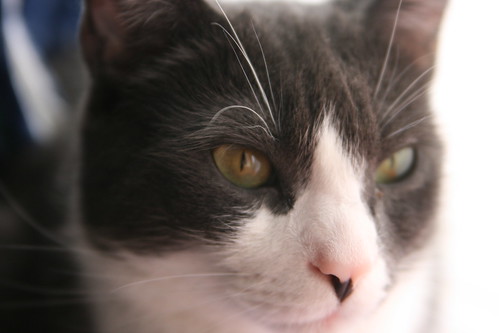
7) Cats are delightful creatures (glory be to God for cats!) but most of them make me sneezy and otherwise ill.

8) I like to grind my coffee beans as I use them up. I really can't tell whether this tastes better than if I were to grind the beans in-store; but if it were too easy to *make* the coffee all at once, I'd probably drink far too much!

9) "You have only one choice" really should mean "here is an exhaustive list of pairwise exclusive options; choose one". People mostly use it to mean "you have only one option --- no choice". Perhaps we don't like to sound as though we're taking away choice; but sometimes, the options really are trivial, and the physics or morals of a situation constrain what we can or may do --- and then it's cowardly not to recognize it. The fact about me is that it REALLY BUGS ME that in Peter Jackson's "Fellowship of the Ring" Elrond says "You have only one choice: ..." and goes on to identify the only procedural option for solving the Ring threat. The "one choice" really is "who's it gonna be?", not "you must throw it into the fire".

10) I often watched Square One! when I was a wee lad. It was fun!

That is all!

the usual suspects

P.S.:
VEXILLA Regis prodeunt;
fulget Crucis mysterium,
quo carne carnis conditor
suspensus est patibulo.